
Pump-priming Funding, Part 2 Summary
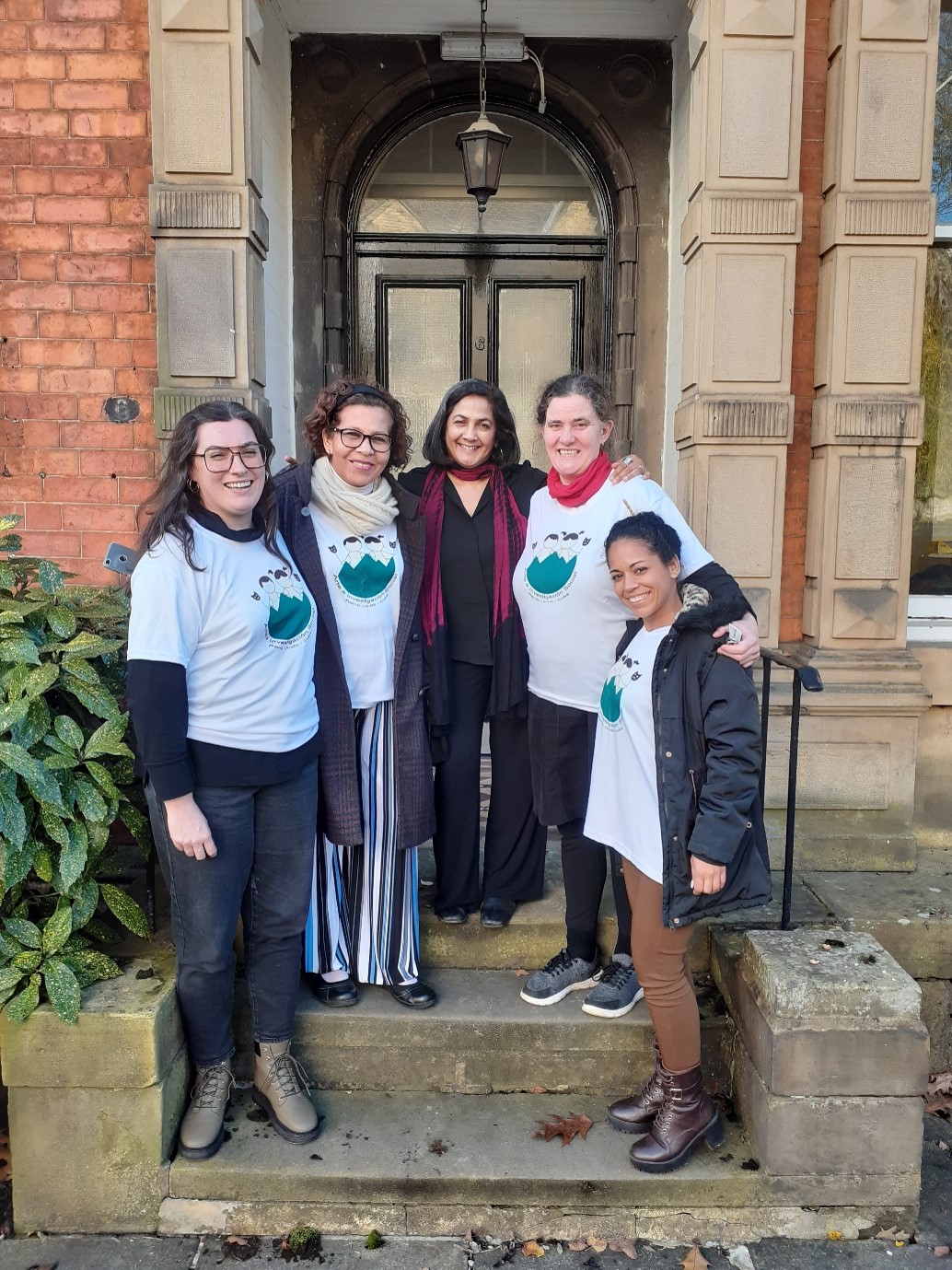
Dr Anne Luke, Lecturer in Childhood Studies, writes about the second part of her exploratory project on children and the arts in Cuba and the UK, when she welcomed two arts professionals from the Granma province of Cuba to Leeds University.

Project Logo designed by José, aged 14, Bayamo, Cuba
After my visit to the Granma province of Cuba in June 2023, the second part of my pump-priming funding was used to bring two visitors from Cuba to the UK to further develop our project on “Social education, arts and post-crisis recovery: comparative theatrical pedagogy as key to unleashing children's potential. A comparative participatory research project on arts education in Cuba and the United Kingdom at a community level.”
Our visitors were Yamisleidis Reyes Beltrán, who is the Artistic Director of two theatre companies based in Bayamo in the Granma province of Cuba: Guerilla de Teatreros, a travelling theatre company established in the early years of the Cuban revolution in the tradition of radical itinerant theatre, and Teatro Guiñol, a puppet theatre company also established from a long theatrical tradition. Yamisleidis is the only theatre director in Cuba to run two companies. Our second visitor was Mariann Muñoz Brunet, an Instructora de Arte (Arts Instructor) who works for the Casa de Cultura (Cultural Hub) in the sugar mill town of Bartolomé Masó, who takes dance, music and theatre workshops and productions deep into the Cuban countryside into areas which may only be accessible by bus once a week.

Teatro Guiñol puppet theatre in action in Granma province, Cuba
I had met and discussed the project with Yamisleidis and Mariann when I was in Cuba, and the project had already taken on its own life, with Cuban 14 year old José designing a logo for us and the Cuban visitors arriving with T-shirts ready for the project team.
The visit allowed us to do several activities to propel our proposed project forward. We had a full meeting of all the proposed project partners, including Children’s theatre companies and arts practitioners from Leeds and co-Investigators from Nottingham. We were able to go out into the community with our Leeds partners to see work with/for children in action. Of particular note was our visit to a park in the Harehills area of Leeds where one of our partners has run hip hop workshops with young people (pictured). The in situ dialogue that developed between our practitioners from both countries was rich and diverse, and gave an indication of the clear value of our project and its potential impact. Similarly, a visit to a rehearsal by a children’s theatre company allowed theatre directors from both countries to discuss writing and directing for their group of actors (and possibilities of cross-lingual writing collaborations), and performing both in theatres and in the community.

In Harehills, Leeds with Mani Ray from North Star Collectives and Invizible Circle Education
We visited Nottingham University to present our proposed project to an audience of Cuba specialists at the Cuba Research Forum, the academic association for multidisciplinary research in Cuba on whose International Executive Committee I sit.

Emeritus Professor Antoni Kapcia on a visit to the Hennessey Collection archive of Cuban materials, Centre for Research on Cuba, Nottingham
Finally, we returned to the University of Leeds to present our project at a bilingual Spanish/English research afternoon hosted by the Inclusion, Childhood and Youth Research Centre celebrating the School of Education’s Latin America research, which saw Yamisleidis and Mariann present alongside researchers based here in Leeds at the School of Education working in Chile, Mexico and Ecuador.
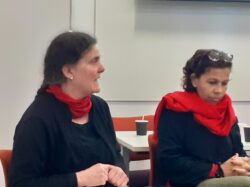
PI Anne Luke and theatre director Yamisleidis Reyes Beltrán presenting at the University of Leeds School of Education’s Latin America event
The next step is the application for external funding. The possibility of success is much greater than would have been the case without the two stages of the pump priming funding, and funders now are becoming more positive to the idea of practitioners as co-investigators, which is a possibility we are actively exploring. As I mentioned in my write up of the first stage of this pump-priming funded activity, this is not a “low hanging fruit” project and its challenges are substantial. For our Cuban colleagues to even travel to the UK necessitated a long journey via Istanbul for visa reasons. Both countries have an arts sector which is cripplingly under-resourced, in Cuba because of financial crisis and the continued US blockade, and in the UK because this crucial work with and for children is easily overlooked by those with the potential power to resource it. Access to the arts is a clear fulcrum around which our discussions will develop. But it is certain that by understanding the process of children’s relationship with the arts, and by seeing constructions of childhood meet and interact, our understanding is and will be deepened and strengthened in order to advocate for children’s well-being through the arts in a global sense.